Bonds
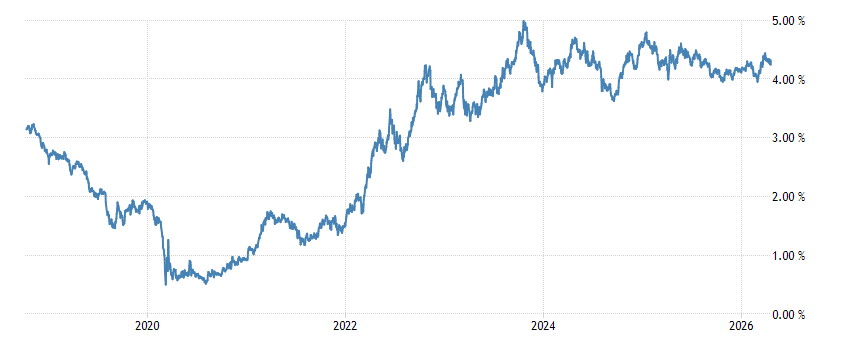
USA 10-year Government Benchmark bond yield
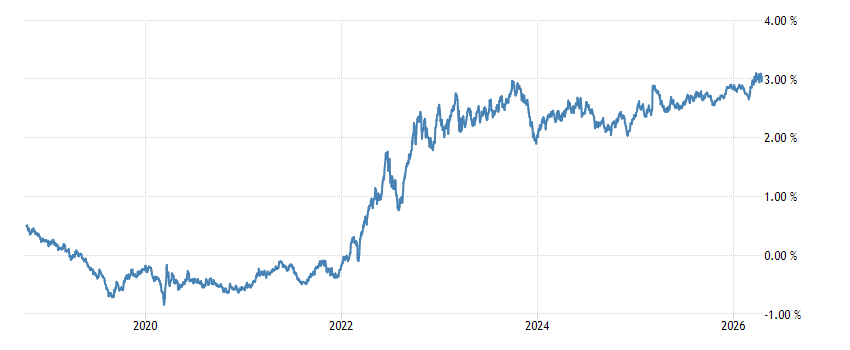
Germany 10-year Government bond yield
Bloomberg Euro Corporate Bond
US Corporate Bond Index
BARRON'S CONFIDENCE INDEX
SHORT TERM CHART
LONG TERM CHART
BARRON'S CONFIDENCE INDEX
(*) Barron's Confidence Index is rooted in the notion that bond traders are more sophisticated than stock investors and that, as a result, their actions are more predictive of future market activity. Since bond prices and yields are inversely related, the theory posits that optimistic investors are more likely to invest in riskier, lower-quality bonds, thereby driving the yields of these bonds lower.
Index measuring the ratio of the average yield on 10 top-grade bonds to the average yield on 10 intermediate-grade bonds:
Barron's Confidence Index = (average yield on 10 top-grade bonds ÷ average yield on 10 intermediate-grade bonds) x 100
From a mathematical perspective, the Barron's Confidence Index should always be less than, or equal to, 100 percent given that yields on top-grade bonds are always lower than yields on lesser-grade bonds. For example, if the average yield of high-grade bonds is 2.5 percent and the average yield of the intermediate-grade bonds is 3 percent, the Barron's Confidence Index is 83.33 percent (2.5 percent divided by 3 percent and multiplied by 100).
The discrepancy between high-rated top-grade bonds and low-rated bond yields establishes a measure that is indicative of investor confidence. When investors are confident about the economy's future, they are willing to take more risk and buy more speculative bonds. The price of higher-quality bonds then goes down, which increases their yield. This dynamic indicates investors need lower premiums in returns to take on increased risk. An index around 80 percent is considered a bearish outlook for the stock market. When confidence in the economy is low, investors seek higher quality debt, which increases bond prices and lowers yields.